

End-to-end management with Sage X3: structure, manage and secure your projects.
When business management becomes a strategic issue:
In many companies, profitability is not about overall activity, but about business.
Each project mobilizes resources, generates costs, commits deadlines and exposes the company to operational and financial risks.
However, case management often remains partial, broken between several tools or followed a posteriori, once the differences have already been noted.
This is precisely what end-to-end management with Sage X3 helps to avoid.
Why is business management still failing in many companies?
1) A fragmented vision of the project:
In many cases, project information is dispersed between accounting, purchasing, production, billing and reporting.
Outcome:
-The actual costs are known too late.
- Margins are calculated after the fact.
- The drifts are not anticipated.
Without a single benchmark, pilotage becomes reactive rather than preventive.
2) A financial monitoring disconnected from the transaction:
Following a project only through accounting statements does not allow you to understand what is actually happening in the field.
Project leaders lack visibility on:
- Current budget consumption.
-Real progress vs. forecast.
- Impact of changes or unforeseen.
Business management must link operations and finance in real time.
3) A difficulty in measuring real profitability per case.
Without clear structuring, it becomes complex to answer key questions:
-What business is really profitable.
-Where are the overtakings?
-What types of projects generate the most margin.
Strategic decision-making is limited.
End-to-end management with Sage X3: a structured approach.
1) A project as the backbone of the system.
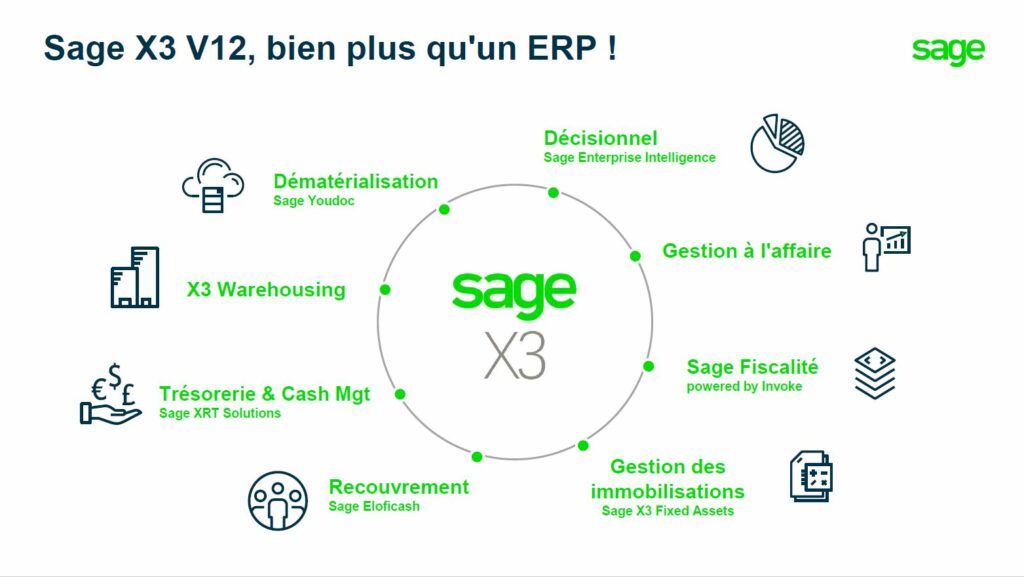
With Sage X3, the case becomes a central axis around which all flows are articulated:
Buy.
-Stocks.
Production.
-Time and resources.
-Facturing.
-Analytical accounting.
Each movement is linked to a case, ensuring complete traceability.
2) Real-time cost and margin management.
Business management allows us to follow:
-Costs incurred vs initial budget.
- Actual vs. forecast costs.
- The margin at the end.
-Variances during the project.
The company no longer suffers the drifts, it anticipates them.
3) Better collaboration between teams.
By centralizing project data, Sage X3 facilitates collaboration between:
- Direction.
Project leaders.
-Finance.
Buy.
Production.
Everyone works on a unique, reliable and shared information.
The concrete benefits of controlled case management.
(1) For management.
- Clear vision of profitability by project.
- Better business prioritization.
- Decisions based on reliable data.
2) For the project leaders.
-Precise tracking of promotion.
- Controlling costs and deadlines.
- Ability to react quickly.
3) For finance.
-Complete traceability of loads and products.
- Fine margin analysis.
- Alignment between operational and accounting.
Errors to avoid when setting up.
Limit business management to simple accounting monitoring.
Do not involve operational teams from the start.
Underestimating the importance of analytical parameterization.
Lack of clear steering indicators.
Business management is primarily an organizational approach, not just an ERP module.
Conclusion:
End-to-end management with Sage X3 allows each project to be turned into a steering centre, not a simple accounting line.
By structuring data, linking finance and operations, and providing a real-time vision, the company secures its margins, improves its performance and increases its capacity to anticipate.
Business management becomes a real lever of governance and growth.