

The 5 errors to avoid when deploying an ERP Sage.
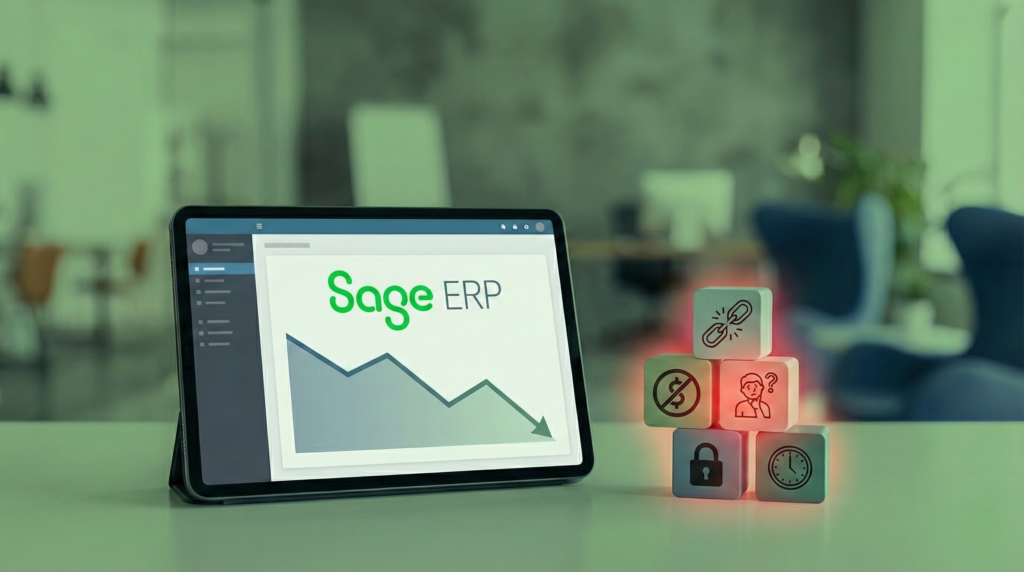
Implementing an Enterprise Resource Planning (ERP) like Sage is a structuring step for any growing business. This is an ambitious project that promises to unify your data and optimize your processes. However, the complexity of such integration can quickly turn the dream into a technical and organisational challenge if certain precautions are not taken.
Success depends not only on the power of the software, but above all on the method of deployment. Identifying traditional upstream traps is the best way to secure your investment and ensure quick adoption by your teams.
Neglect needs analysis and framing:
The most frequent error occurs long before the installation of the software: this is the lack of precision in the definition of needs. To go too fast without writing a detailed specification is risky. It is crucial to audit your current processes to distinguish what needs to be replicated from what needs to be improved by the management solution.
Do not underestimate the importance of management involvement. An ERP project should not be seen as a simple IT project, but as a business project. Without a strong sponsor on the steering committee to arbitrate decisions and maintain strategic direction, the project risks simmering into endless operational debates.
Underestimating the human impact and the conduct of change:
An LES changes daily working habits. A major mistake is to focus only on the technical aspect (servers, features, code) by forgetting end users. Resistance to change is natural; It must be anticipated by transparent and regular communication on the concrete benefits for each occupation.
Similarly, thinking that training can be done "on the job" is a dangerous calculation. A plan of structured training and adapted to each user profile is essential to avoid a drop in productivity at the time of startup (Go-Live).
Migration of "salt" data: Transferring obsolete or duplicate data to your new Sage system will pollute your new tool from day one. Take advantage of migration to clean and qualify your basics.
Over-personalization (specific): Wanting to twist the software to do exactly as the old system is a costly mistake. Focus on standard ERP Sage processes, often based on best market practices.
The absence of a rigorous test phase: Do nothing on a complete receting (unit tests and end-to-end tests) exposes you to critical bugs in production. Involve key users in this phase.
An unrealistic calendar: Under pressure, reducing deployment times often leads to sacrifice of quality or training. Provide room for contingency.